Is It “Brazilian” or “Portuguese”? What Brazil Actually Speaks

By Bruno Lopes · Brazilian Portuguese teacher
Host of I Speak Portuguese · Updated
Meet Bruno and the teaching teamThe straight answer
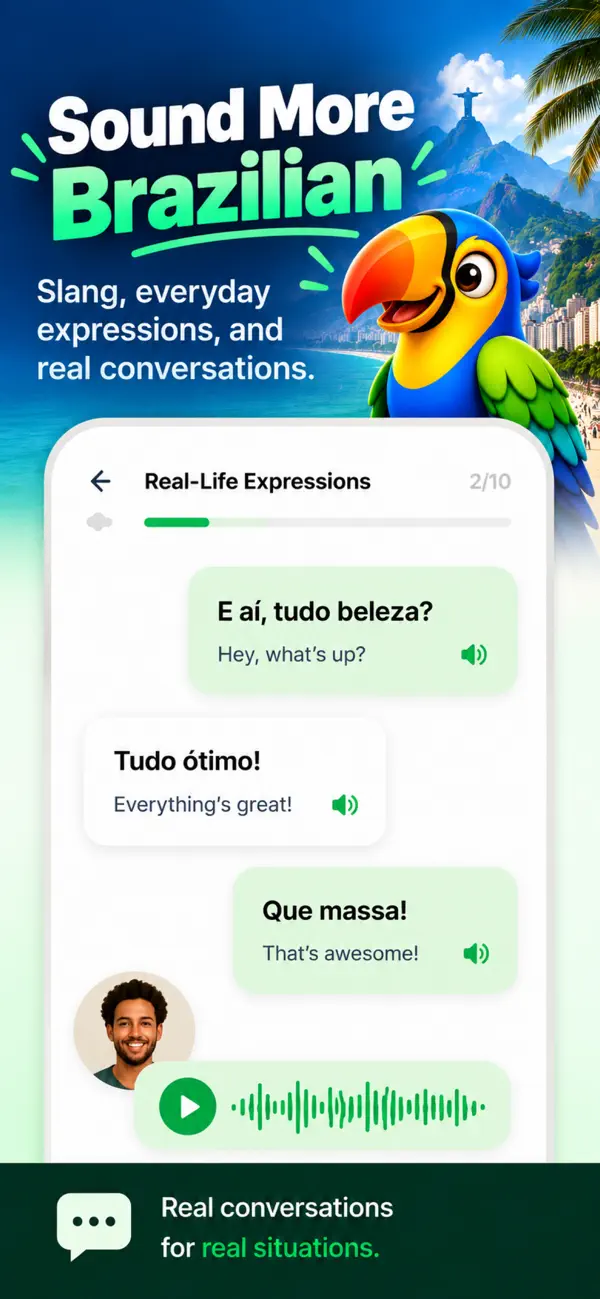
Brazil speaks Portuguese. The variety is called Brazilian Portuguese (português brasileiro, code PT-BR). "Brazilian" on its own is a nationality, not a language — the same way "American" isn't a language even though American English clearly exists.
Article 13 of Brazil's Constitution identifies Portuguese as the country's official language. That tells you the official name; it does not mean everyone in Brazil has the same accent or speaks only one language.
No, it isn't Spanish
Brazil is the only country in South America whose official language is Portuguese. The confusion is understandable — the two languages are close relatives and share a lot of written vocabulary — but they aren't interchangeable:
| English | Portuguese (BR) | Spanish |
|---|---|---|
| Thank you | Obrigado | Gracias |
| Yes | Sim | Sí |
| Very | Muito | Muy |
| Street | Rua | Calle |
| Window | Janela | Ventana |
| To speak | Falar | Hablar |
Shared written words can help a Spanish speaker, but they do not guarantee understanding of spoken Portuguese. Listen to Portuguese itself rather than relying on a Spanish pronunciation of words that look familiar.
Brazilian vs. European Portuguese
Same language, different flavor. The differences a learner meets first:
| Feature | Brazil (PT-BR) | Portugal (PT-PT) |
|---|---|---|
| Addressing someone | Você and tu; usage varies by region and relationship | Tu is common in informal relationships; forms of address vary with context |
| Unstressed vowels | Patterns vary by accent | Often more reduced in European varieties |
| "de" sound | May sound like "jee" in many accents, but not all | The consonant is generally pronounced as a "d" |
| Present continuous | estou falando | estou a falar |
| Train | trem | comboio |
| Bus | ônibus | autocarro |
| Cell phone | celular | telemóvel |
Deeper comparison here: Brazilian vs. European Portuguese.
What about accents inside Brazil?
You will hear different pronunciations and forms of address in Rio de Janeiro, São Paulo, northeastern Brazil and southern Brazil—and differences within those places too. Avoid treating one speaker as the model for an entire region. You can ask someone to repeat a word or speak more slowly while you get used to their accent.
Which one should you learn?
- Choose Brazilian Portuguese if you plan to travel to Brazil, speak with a Brazilian partner or family, or follow Brazilian media.
- Choose European Portuguese if you're moving to Portugal, applying for citizenship there, or your family is Portuguese.
- You can explore both. Start with the variety you will use most, then add listening practice and vocabulary from the other. There is no fixed timetable for understanding unfamiliar accents.
Useful phrases to say it correctly
| Portuguese | English |
|---|---|
| Eu falo português. | I speak Portuguese. |
| Estou aprendendo português brasileiro. | I'm learning Brazilian Portuguese. |
| No Brasil se fala português, não espanhol. | In Brazil people speak Portuguese, not Spanish. |
| Meu português ainda é básico. | My Portuguese is still basic. |
| Pode falar mais devagar, por favor? | Could you speak more slowly, please? |
Try a real introduction in Portuguese
Use this original practice dialogue to explain what you are learning. These lines are teaching examples, not quotations from a podcast or video.
| Speaker | Portuguese | English |
|---|---|---|
| A | Você fala português? | Do you speak Portuguese? |
| B | Um pouco. Estou aprendendo português brasileiro. | A little. I'm learning Brazilian Portuguese. |
| A | Por que você está aprendendo? | Why are you learning? |
| B | Quero conversar com a família do meu parceiro. | I want to talk with my partner's family. |
If your partner is a woman, you can use da minha parceira instead of do meu parceiro. For travel, replace the last answer with Vou viajar para o Brasil. — “I'm going to travel to Brazil.”
Choose the phrase that fits your situation
Say your answer aloud before opening each explanation. You can complete this practice without memorizing every difference between the two varieties.
- You are choosing materials for a trip to Brazil. Would you search for Brazilian, Spanish, or Brazilian Portuguese?
- You are still a beginner. How would you say “My Portuguese is still basic”?
- Someone answers faster than you can follow. How would you ask them to speak more slowly?
Check answer 1: the language you are learning
Brazilian Portuguese. The language is Portuguese; Brazilian identifies the variety. Try saying Estou aprendendo português brasileiro.
Check answer 2: describe your level
Meu português ainda é básico.
Ainda means “still.” This sentence describes your current level without stopping the conversation.
Check answer 3: ask for a slower reply
Pode falar mais devagar, por favor?
Mais devagar means “more slowly.” Another useful request is Pode repetir, por favor? — “Could you repeat that, please?”
Finish with your own two-sentence introduction: Estou aprendendo português brasileiro. Quero… Add one real reason, such as viajar para o Brasil or conversar com minha família. Continue with our guide to learning Portuguese with a Brazilian partner or Portuguese phrases for travel.
English summary for learners
- There is no "Brazilian" language — Brazil speaks Portuguese (PT-BR).
- Portuguese is Brazil's official language; do not assume a Brazilian speaker knows Spanish.
- Brazilian and European Portuguese are one language with US/UK-style differences.
- Choose the variety that fits the people and places you want to connect with.
- Say: Estou aprendendo português brasileiro.
If you've decided on the Brazilian variety, the I Speak Portuguese podcast is a free way to get your ear used to real Brazilian speech from day one.
Frequently asked questions
Is there a language called Brazilian?
Brazil's official language is Portuguese. For courses, dictionaries and software settings, Brazilian Portuguese names the variety used in Brazil. 'Brazilian' alone usually describes a nationality; ask for Brazilian Portuguese when choosing learning materials.
Do Brazilians speak Spanish?
Spanish is not Brazil's official language; Portuguese is. Some Brazilians also speak Spanish, but you should not assume that everyone does. Portuguese and Spanish are distinct languages, even when written words look similar.
Is Brazilian Portuguese the same as Portugal's Portuguese?
They are varieties of the same language, with differences in pronunciation, everyday vocabulary and usage. Regional accents also vary within each country. Listening practice with the people you plan to speak to helps you get used to those differences.
Which Portuguese should I learn — Brazilian or European?
Choose Brazilian Portuguese if your main conversations, travel or relationships are in Brazil. Choose European Portuguese if your main goal is Portugal. Neither variety is universally easier; familiarity with the voices and situations you practice matters.
Is Brazilian Portuguese hard for English speakers?
It's one of the more approachable languages for English speakers: Latin alphabet, lots of shared vocabulary, and predictable spelling. The main hurdles are nasal vowels, verb conjugation, and the ser/estar split.
What does 'PT-BR' mean?
PT-BR is the language code for Brazilian Portuguese, while PT-PT is European Portuguese. You'll see them on software settings, Netflix audio tracks, and course listings to indicate which variety is used.