Share Your Opinion in Brazilian Portuguese

By Bruno Lopes · Brazilian Portuguese teacher
Host of I Speak Portuguese · Updated
Meet Bruno and the teaching teamUseful phrases for sharing an opinion
Start with a short frame, then add your idea. These examples are original and can be adapted to topics you actually care about.
| Portuguese | Meaning | Use |
|---|---|---|
| Eu acho que... | I think that... | A flexible, everyday way to introduce a view. |
| Na minha opinião... | In my opinion... | Clearly marks what follows as your perspective. |
| Pra mim... | To me... / For me... | Common conversational wording; meaning depends on context. |
| Eu diria que... | I would say that... | Offers a measured or thoughtful opinion. |
| Depende. | It depends. | A useful answer when the situation has more than one side. |
Agree or disagree without ending the conversation
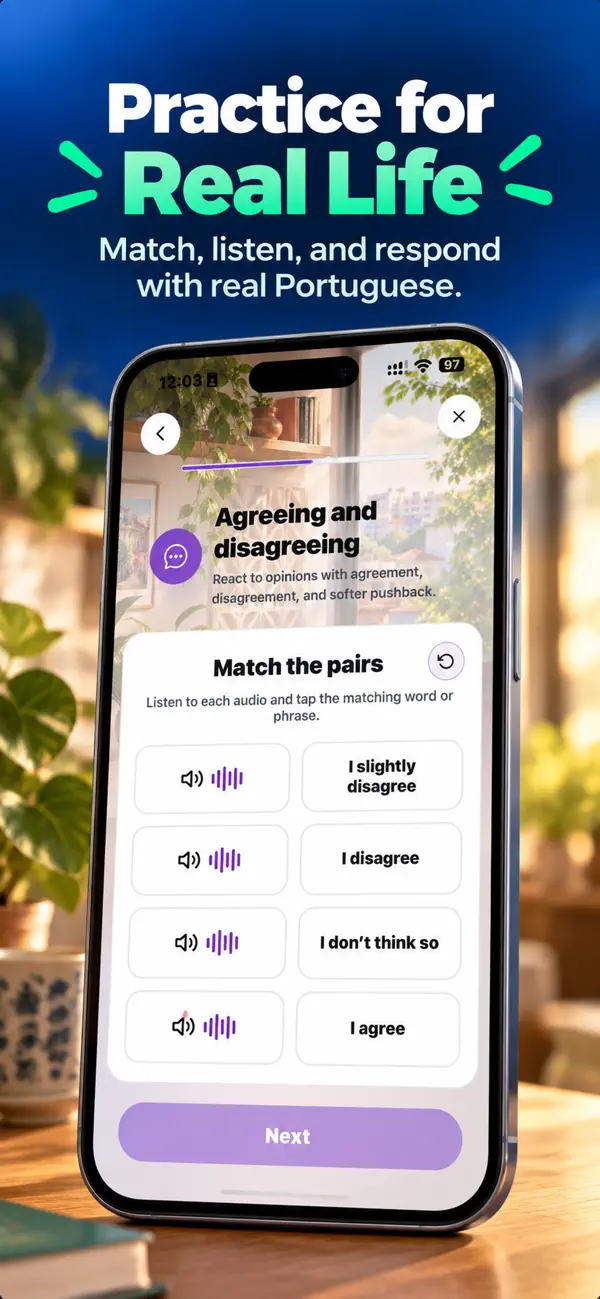
Conversation is more than saying sim or não. Acknowledge what the other person said before you add a different view:
- Concordo com você. — I agree with you.
- Faz sentido. — That makes sense.
- Entendo, mas vejo de outro jeito. — I understand, but I see it differently.
- Não sei se concordo totalmente. — I’m not sure I completely agree.
- Acho que depende da situação. — I think it depends on the situation.
These are options, not rules for every situation. A friendly tone, facial expression, and the relationship between speakers all affect how direct an answer feels.
Practice a short conversation
This original dialogue shows how to respond, add a reason, and invite the other person to continue.
A: Você prefere morar numa cidade grande ou pequena?
Do you prefer living in a big city or a small one?
B: Pra mim, uma cidade menor é mais tranquila.
For me, a smaller city is more peaceful.
A: Entendo. Eu gosto da facilidade de encontrar tudo numa cidade grande.
I understand. I like how easy it is to find everything in a big city.
B: Faz sentido. Acho que depende da fase da vida.
That makes sense. I think it depends on your stage of life.
A simple formula to answer with more detail
- State your view: Eu acho que...
- Give one reason: porque... (“because…”)
- Invite a response: E você? (“And you?”)
For example: Eu acho que caminhar é uma ótima forma de conhecer uma cidade, porque você percebe mais detalhes. E você? — “I think walking is a great way to get to know a city because you notice more details. What about you?”
Listen for opinion phrases
Play the episode once for its main idea. On the second listen, notice how the speaker introduces a thought or reacts to another point. Then pause and say one opinion of your own using acho que or pra mim.
Keep practicing with the Real Life Portuguese app. For live speaking practice, meet the teaching team in a trial lesson, or talk with other learners in the community.
Frequently asked questions
How do I say ‘I think’ in Brazilian Portuguese?
Use ‘Eu acho que...’ before a statement. For example, ‘Eu acho que essa ideia é boa’ means ‘I think this idea is good.’ In casual speech, people often omit eu and say ‘Acho que...’
How do I disagree politely in Portuguese?
You can soften a disagreement with ‘Entendo, mas...’ (I understand, but...), ‘Eu vejo de outro jeito’ (I see it differently), or ‘Não sei se concordo’ (I’m not sure I agree). Tone and context matter.
What is the difference between ‘pra mim’ and ‘na minha opinião’?
Both can introduce a personal view. ‘Na minha opinião’ clearly means ‘in my opinion’ and sounds a little more explicit. ‘Pra mim’ is common in conversation and can mean ‘for me’ or ‘to me,’ depending on context.