Freeze When Speaking Portuguese? Four Ways to Keep Talking
1. Give listening its own practice time
Bruno points out that reading subtitles while listening can turn much of the task into reading. His suggestion is to spend some time listening without written support, because an everyday conversation will not come with captions.
You can make this manageable by working with a short section. Try 20–30 seconds of the episode, and ask yourself: who is speaking, what is the topic, and what is the main point? You do not need every word to understand the message.
Then check the subtitles or replay the difficult part. Finish by listening again without reading. This three-step exercise is a companion practice activity for the episode; adjust the length if the audio feels too difficult.
2. Prepare answers to questions you hear repeatedly
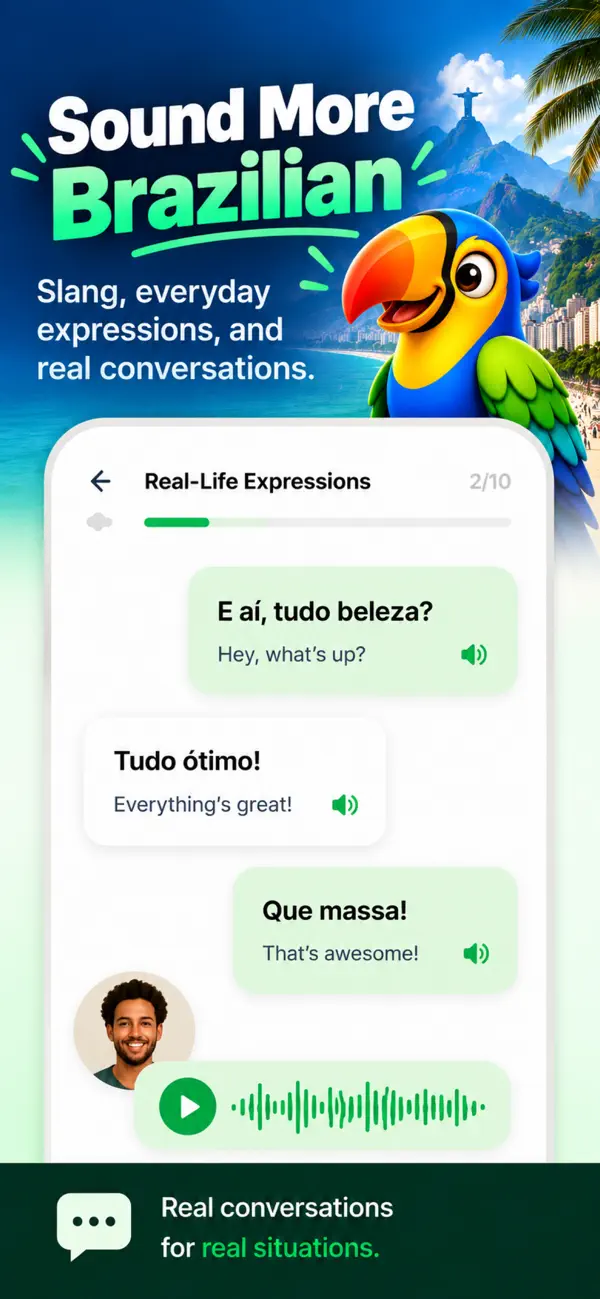
Bruno and Sabrina focus on the opening questions that come up when you meet someone. If you have practiced these exchanges aloud, you have fewer decisions to make during the conversation.
| Question | Meaning | Practice answer |
|---|---|---|
| Tudo bem? | How are you? | Tudo bem, e você? |
| Qual é o seu nome? | What's your name? | Meu nome é Alex. |
| O que você faz? | What do you do? | Eu trabalho em uma escola. |
| De onde você é? | Where are you from? | Eu sou do Canadá. |
| Por que você está aqui? | Why are you here? | Estou aqui de férias. |
The questions come from the episode; the answers above are new practice examples. Replace the name, country, job, and reason with your own information. Learn an answer you can use, rather than memorizing an invented identity.
Next, change one detail. Try talking about a past job or a different trip. A familiar sentence pattern becomes more useful when you can adapt it.
3. Use a natural pause when you need time
You do not have to start every answer immediately. Sabrina demonstrates então while thinking about a favorite film. The conversation also covers sabe and tipo.
- Então… eu acho que… — Well… I think…
- Sabe… — You know…
- Tipo… — Like…
These words do not have one fixed translation in every sentence. They can organize a thought or mark a pause. Sabrina also mentions daí, which she uses as a speaker from southern Brazil.
Use a pause word when it helps, then finish your thought. Repeating tipo throughout every sentence can distract from your message. Listen for how the hosts use the words, including the timing and intonation.
4. Build connections between words and real things
The final strategy is to reduce the extra step of translating every word through English. Bruno suggests connecting Portuguese sounds directly to objects and situations. He gives examples such as coco (coconut), vela (candle), mesa (table), and escritório (office).
Try looking at a table and saying mesa, then a mesa, then O livro está na mesa — “The book is on the table.” This is a new exercise extending the episode's suggestion.
Translation is a normal part of learning. The aim is to make familiar words easier to retrieve, especially when you have little time to respond.
A five-minute speaking routine
- Listen to one short section without reading.
- Say your answer to one small-talk question.
- Answer a new question, allowing yourself a short pause.
- Name three things around you and describe one in a sentence.
- Repeat your first answer with one changed detail.
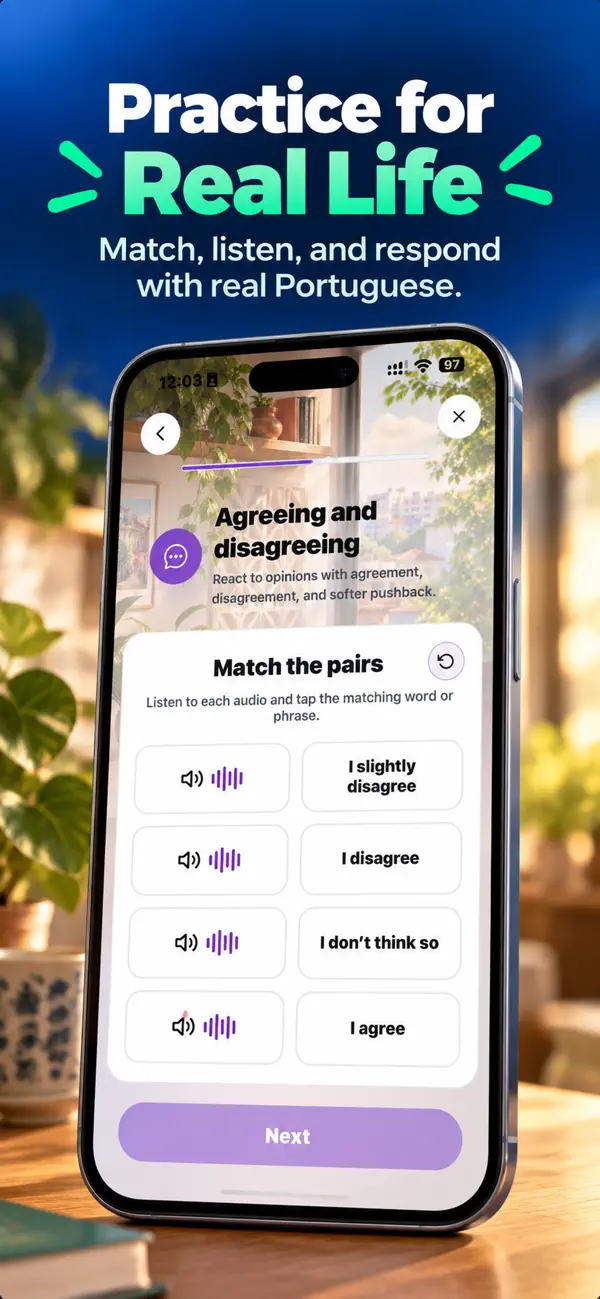
Use the Real Life Portuguese app for more everyday language practice. If you want feedback on the answers you use most, bring them to a trial lesson with a Brazilian teacher.
Frequently asked questions
Why can I understand Portuguese but struggle to speak?
Recognizing words and producing a response are different tasks. Speaking also involves choosing words, organizing a sentence, and managing the conversation. Practice short answers you need in real situations, then gradually vary them.
What can I say while thinking of an answer in Portuguese?
Então (well/so), sabe (you know), and tipo (like) can create natural pauses in informal speech. Use them occasionally, followed by your answer. A quiet pause is also fine.
Should I stop using subtitles completely?
You can use subtitles to check what you heard. Try one short section without them, check the difficult parts, and listen again without reading. Match the difficulty to your level.