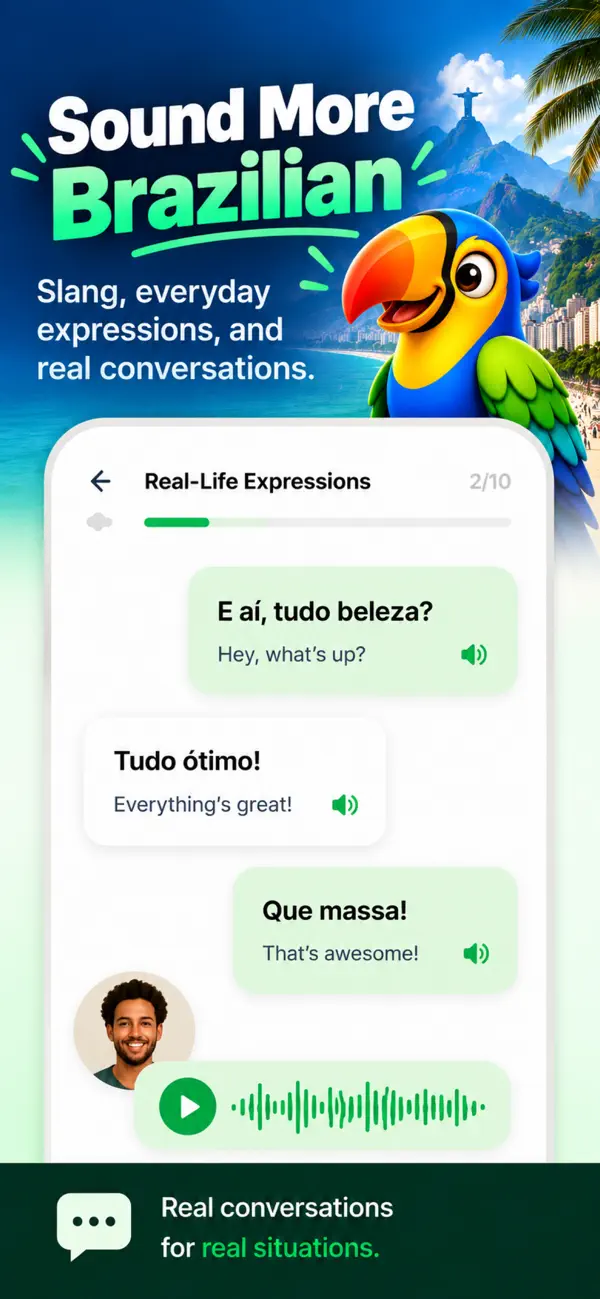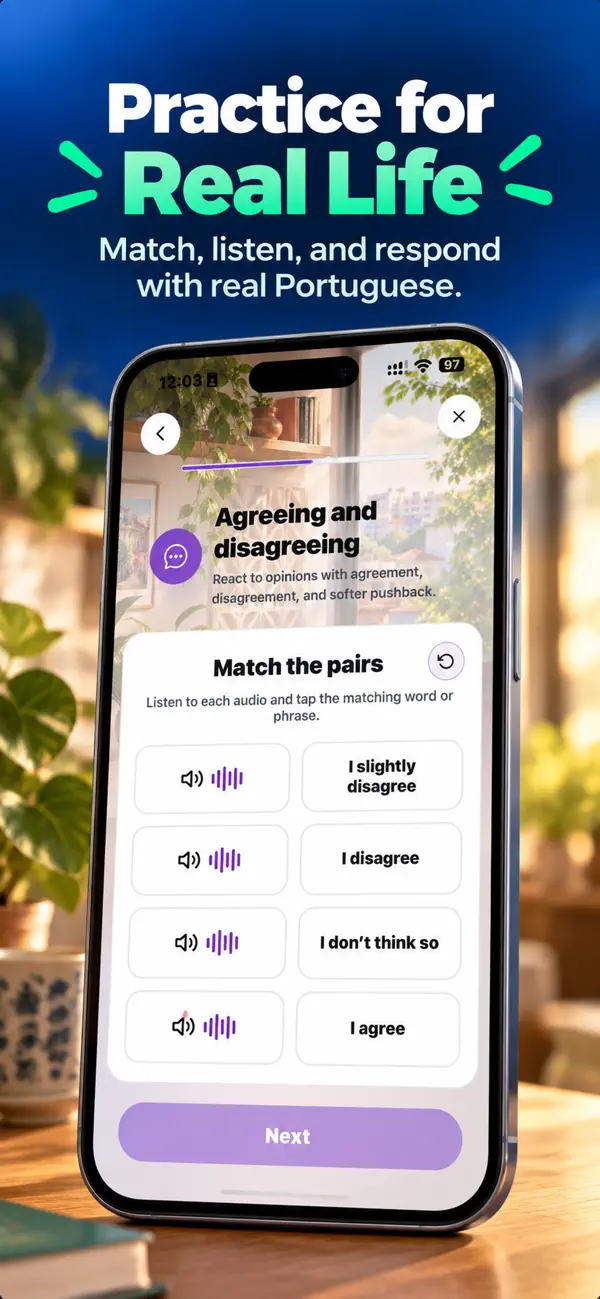
7 Brazilian Portuguese Expressions You’ll Hear Every Day

By Bruno Lopes · Brazilian Portuguese teacher
Host of I Speak Portuguese · Updated
Meet Bruno and the teaching teamA quick guide to the expressions
| Portuguese | Meaning in conversation | When to use it |
|---|---|---|
| Imagina | You’re welcome / no problem | Responding to thanks |
| Bora | Let’s go / let’s do it | Inviting someone or accepting |
| Pois é | Yeah / that’s true | Acknowledging what someone said |
| Mó | Really / very | Adding emphasis in slang |
| Valeu | Thanks | Casual appreciation |
| Me vê… | Can I get…? | Ordering food or a drink |
| Até a próxima / a gente se vê | Until next time / see you | Ending a conversation |
These translations describe what the expressions do in conversation. Translating each word literally often misses the point. The short practice dialogues below are additional examples you can use alongside the video.
1. Imagina: a natural reply to “thank you”
In the opening example, Bruno describes someone buying him a coffee. He says thank you, and the other person can answer imagina. Here, nobody is asking anyone to imagine something. The expression reassures the other person that the favor was no trouble.
- A: Obrigada pelo café! — Thanks for the coffee!
- B: Imagina! — Don’t mention it!
De nada also works. Learn to recognize both, rather than expecting every Brazilian to use the same reply. For more options, see our guide to thanking someone in Portuguese.
2. Bora: invite someone and say yes
Bora is a casual invitation to go somewhere or do something. Bruno uses coffee, going out, and the gym as examples. It is also a complete answer when you want to join in.
- A: Bora tomar um café amanhã? — Want to grab a coffee tomorrow?
- B: Bora! — Let’s do it!
Try the reusable pattern bora + verb: bora estudar, bora conversar, or bora sair. With friends, it sounds relaxed. In a formal situation, vamos or a fuller invitation may fit better.
3. Pois é: acknowledge what someone said
Bruno explains pois é through a conversation about cloudy weather. It can show agreement or recognition: “Yeah,” “That’s true,” or “I know.” It also gives you a natural moment to gather your next thought.
- A: Hoje está muito quente. — It’s really hot today.
- B: Pois é. Vamos tomar alguma coisa? — Yeah. Shall we get something to drink?
Listen to the tone. The same expression can sound enthusiastic, resigned, or thoughtful. Use it when you are acknowledging what was said; it is not a substitute for every English “yes.”
4. Mó: add emphasis in a casual conversation
Mó is slang that adds emphasis. In the lesson, Bruno gives Brasília é mó legal: “Brasília is really cool.” In this kind of sentence it works like an informal muito.
Practice: Esse lugar é mó legal! — “This place is really cool!”
Usage varies between speakers and regions. Start by recognizing it in casual speech. Keep muito as your reliable option for formal writing or when you are unsure of the tone.
5. Valeu: say thanks informally
A friend brings you a drink. Instead of a longer thank-you, you can say valeu. Bruno also gives more casual variations such as pô, valeu and valeu, mano.
- A: Aqui está seu café. — Here’s your coffee.
- B: Valeu! — Thanks!
You do not need to add mano. A simple valeu is enough. Choose obrigado or obrigada when you want a more neutral thank-you.
6. Me vê: order at a café or bar
Me vê um café, por favor is a natural casual order: “Can I get a coffee, please?” The literal English translation of me vê does not explain its function here.
- Me vê uma cerveja, por favor. — Can I get a beer, please?
- Pode ser um café gelado. — An iced coffee would be good.
Bruno introduces several ordering options. Eu gostaria de um café is also correct; it is simply more formal than these casual patterns. Avoid translating “I’ll have a coffee” word for word as eu vou ter um café. For a complete ordering dialogue, read our Brazilian bakery guide.
7. Say goodbye in a way that fits the relationship
The final group in the lesson covers goodbyes. Tchau is familiar, but friends may also close a conversation with valeu, tamo junto, or é nóis.
The last two are very informal expressions of solidarity and familiarity. You do not need to use them with everyone. Até a próxima (“Until next time”) and a gente se vê (“See you”) are more neutral choices.
- Valeu! Até a próxima. — Thanks! Until next time.
- Tchau! A gente se vê. — Bye! See you.
Practice: choose a reply that fits
Say your answers aloud before revealing the suggestions. More than one response can work; these are opportunities to practice the expressions from the lesson.
- A friend says thank you for your help. How could you reply?
- You want to invite a friend for coffee. Start your question with bora.
- Someone comments on how hot it is. Acknowledge the comment.
- Order a coffee politely using me vê.
- End a conversation with a neutral “see you.”
Show suggested answers
- Imagina!
- Bora tomar um café?
- Pois é!
- Me vê um café, por favor.
- A gente se vê!
Turn one expression into a conversation
Choose one expression you could use this week. Return to that part of the video, listen to Bruno’s delivery, and repeat the complete phrase. Then change one detail: the drink, the activity, or the person you are talking to.
Continue practicing everyday language and Brazilian audio in the Real Life Portuguese app. For guidance with your speaking, explore lessons with our Brazilian teaching team.
Listen, then try it yourself
These phrase recordings are by Bruno. Play one, listen again, and repeat it aloud. The dialogue below is an original written practice example; the recordings cover the individual phrases shown here.
Practice a short conversation
- You: Bora tomar um café?
- Shall we grab a coffee?
- Your friend: Bora!
- Let's do it!
- You: Me vê um café, por favor.
- Can I get a coffee, please?
- Staff: Aqui está.
- Here you go.
- You: Valeu!
- Thanks!
Your turn
Say your answers aloud before opening the suggestions. Other answers can work too.
- Accept a casual invitation using bora.
- Reply naturally when someone thanks you.
- End the conversation with a neutral see you.
Show suggested answers
- Bora! — Let's do it!
- Imagina! — Don't mention it!
- A gente se vê! — See you!
Keep practicing everyday phrases and Brazilian audio in the Real Life Portuguese app. For feedback on your own conversations, explore lessons with our Brazilian teaching team.
Frequently asked questions
Does imagina mean imagine or you're welcome?
Both are possible, depending on context. When someone says obrigado or obrigada and you reply imagina, it means something like you're welcome, no problem, or don't mention it.
What does bora mean in Brazilian Portuguese?
Bora is an informal way to say let's go or let's do it. You can use it in an invitation, such as Bora tomar um café?, and as an enthusiastic answer: Bora!
Can valeu mean both thanks and goodbye?
Yes. Valeu can thank someone informally, and it can also close a conversation between friends. The situation tells you which meaning is intended.
Is me vê a polite way to order in Brazil?
Me vê is common in casual ordering at cafés, bars, and similar places. Add por favor and use a friendly tone. Eu gostaria de is also correct and can suit a more formal interaction.